The craft
Patience, Stone & Hand
Six stages, several evenings and many broken blanks go into every blade. This is how it’s done.
The craft
Patience, Stone & Hand
We use no machines and no moulds. Each knife is made the way stone blades were made for thousands of years, with hammerstone, antler and time. Small imperfections stay in, because they are proof it was made by hand.
Selecting the Stone
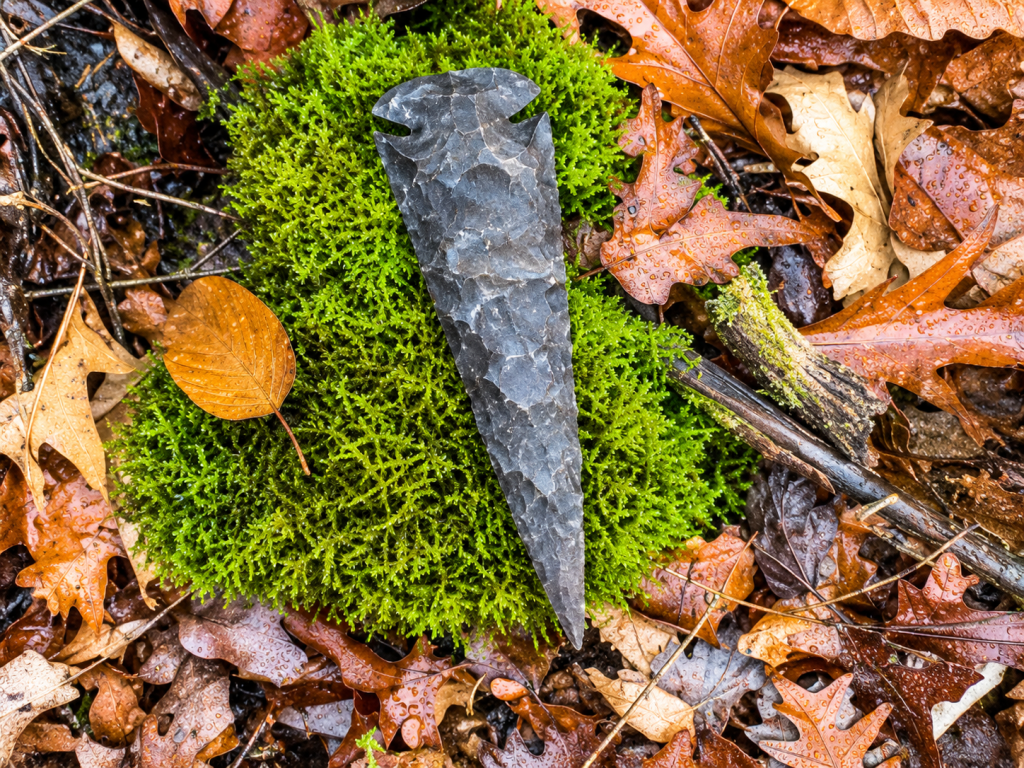
Every knife starts with a stone. We tap each nodule of obsidian and flint and listen: a clear ring means sound stone, a dull note means hidden fractures. We may test twenty pieces to find one worth working.
Shaping the Core
Heavy strikes with a hammerstone knock off the rough outer cortex and set the blade’s rough shape. Every blow has to be planned, because stone cannot be put back once it breaks away.
Flint Knapping
With an antler billet over a leather pad, we take broad, thin flakes across both faces. This is where the long, rippling scars appear, and where the stone decides how far it will go.
Refining the Edge
Pressure flaking with an antler tine takes off tiny flakes, one at a time, along the edge. It is slow work, often a whole evening by lantern light, and it gives the blade its serrated shine.
Handcrafting the Handle
Handles come from fallen branches, shed antler and bone. We cut, season and shape them by hand, and we keep the bark, lichen and knots that make each one its own.
Final Assembly
The blade is set into the handle with pine pitch, then bound with sinew, rawhide or twine that tightens as it dries. Each finished piece gets its own bark and moss stand.
A small glossary
The Language of Stone
Words you’ll meet on our pages and provenance cards.
Knapping
Shaping stone by controlled fracture, striking or pressing flakes away.
Billet
A baton of antler or hardwood used for soft-hammer percussion.
Pressure flaking
Taking tiny flakes off by pressing with an antler tine. This is how the edge is refined.
Cortex
The weathered outer rind of a nodule, often chalky on flint.
Conchoidal fracture
The smooth, shell-like curve that glassy stone makes when it breaks.
Hafting
Fixing a blade into its handle with pitch and binding.
Sinew
Dried animal tendon. It shrinks as it dries, so it binds very tightly.
Pine pitch
Tree resin mixed with charcoal, used as a natural glue.
Your blade is waiting
Find the Blade That Speaks to You
Choose a piece already finished on the workbench, or tell us the story you want a blade to carry.